Dear friends, my blog “Mercy Not Sacrifice” is now hosted at Patheos. Come on over!

Another item for Dave Ramsey’s list of what rich people do that poor people don’t do
 Dave Ramsey recently posted on his blog a list of 20 things that rich people do that poor people don’t do (the idea being that poor people are to blame for their poverty). Among the list were that rich people write down their goals, read books, make their kids volunteer, teach good daily success habits to their children, etc. Well, I was reading through my dad’s Economist magazine last night and I found a 21st item to put on Dave’s list. Apparently it’s a growing trend for really rich people to buy expensive artwork, and, instead of hanging it up in their homes, store it in giant, tax-free warehouses in places like Luxembourg to use as investment currency instead of stocks or bonds. Continue reading
Share this:

Are you a pilgrim or a tourist? (Hebrews 11:8-16) #sermon #podcast
 Growing up in the church, I would often hear the phrase, “We’re just pilgrims passing through,” usually in response to someone’s passion for changing the world. It means that since this is not our “true home” (heaven is), we shouldn’t worry about what happens to our world other than keeping our family safe. Hebrews 11 talks about the Israelite patriarchs who “confessed that they were strangers and foreigners on the earth” (v. 13), not because they considered earthly life irrelevant compared to “heaven,” but because they “desired a better country” (v. 16). Those who see our lives on Earth as a brief visit are tourists; those who are seeking a kingdom of God that requires more than one lifetime to build are pilgrims. Which are you?
Continue reading
Growing up in the church, I would often hear the phrase, “We’re just pilgrims passing through,” usually in response to someone’s passion for changing the world. It means that since this is not our “true home” (heaven is), we shouldn’t worry about what happens to our world other than keeping our family safe. Hebrews 11 talks about the Israelite patriarchs who “confessed that they were strangers and foreigners on the earth” (v. 13), not because they considered earthly life irrelevant compared to “heaven,” but because they “desired a better country” (v. 16). Those who see our lives on Earth as a brief visit are tourists; those who are seeking a kingdom of God that requires more than one lifetime to build are pilgrims. Which are you?
Continue reading
Share this:

My duty to the Bible’s living interpretive tradition
 I had a good discussion yesterday with my pastor covenant group about our discernment process as a church in the wake of the Frank Schaefer trial and controversy. I know that I got a little hot-headed in the debate online so I wanted to offer more circumspect reflections. I believe that each disciple of Jesus Christ not only has the right but actually the duty to contribute to the ongoing living interpretive tradition of our faith. Some Christians think that the Bible doesn’t require any interpretation, but I contend that the way we interpret it is by living it and sharing our testimony with each other. Continue reading
Share this:

Justice of the heart and Frank Schaefer
 This week, the United Methodist Church put a pastor on trial named Frank Schaefer for officiating at the wedding of his gay son. The judge, retired bishop Al Gwinn, ruled out as inadmissible any defense arguments based on scripture or other sections of the Book of Discipline, reasoning that only “the facts” of what Schaefer did were relevant to determining the verdict. While I understand the rationale and practical limitations that necessitate this approach to justice, I do not think it does justice to justice. The promise that we receive in scripture is that God judges according to the heart. Hebrews 4:12-13 says: “Indeed, the word of God is living and active, sharper than any two-edged sword, piercing until it divides soul from spirit, joints from marrow; it is able to judge the thoughts and intentions of the heart. And before him no creature is hidden, but all are naked and laid bare to the eyes of the one to whom we must render an account.” Continue reading
Share this:

Is your life NSFJ (not safe for Jesus)?
 Please excuse the gratuitous selfie; I couldn’t think of another graphic to use. I was reading a passage in Greek today and it hit me in a different way than it ever has before. It’s 1 Corinthians 6:12-13, which illustrates how Christian morality differs from a casuistic or legalistic moral system. Few Christians are willing to accept how radical Paul is being when he says, “All things are lawful for me, but not all things are beneficial.” It is a morality that is based not on following a particular set of rules, but on living in such a way that we seek union with Christ. The question is whether our lives are NSFJ (not safe for Jesus). Few Christians are willing to rise to Paul’s challenge so they define their “morality” according to a safe, limited set of rules (often the trinity of “no sex, no drugs, no cussing”) that they don’t have trouble keeping and they can judge others for breaking. Continue reading
Share this:

Why James K.A. Smith should stay off of twitter
 There are few things that make my blood boil more than to see someone take a mean-spirited, unfair swipe against someone else in a public forum like twitter. When this happens, it needs to be named and addressed, especially when the instigator is a popular Christian writer who I’ve promoted on my blog. Rachel Held Evans had expressed support for the student newspaper at Calvin College running a feature piece on LGBT students, which is pretty bold for an evangelical college. And James K.A. Smith, a professor at Calvin and writer of many books that I’ve blogged about, decided that he needed to “humble” Rachel for voicing her support when it’s none of her damn business. Continue reading
Share this:

The United Methodist gay wedding crisis

Richard Taylor and William Gatewood who got married by 50 UMC pastors this past weekend (UMNS: Mike DuBose)
Thomas Frank, the guy who wrote our textbook on United Methodist polity, has made a plea for UMC bishops not to put pastors on trial who conduct same-sex marriages (like the 50 who did so last weekend). I had been trying to lay low on this issue for a while. My position has been to honor what the Discipline says for me to do while being obediently prophetic regarding God’s truth as I have encountered it. I was actually going to write a post stating that if pastors engage in civil disobedience, then the consequences are part of the witness. However, I realized as I read Frank’s plea that the paradigm I was applying to our gay wedding crisis is to presume that United Methodism is appropriately analogous to our broken secular democracy: a two party majoritarian system with lobbyists, caucuses, and hyperventilating pundits.
Share this:

Lord, I thank you that I’m not like those people who thank God they’re not like other people
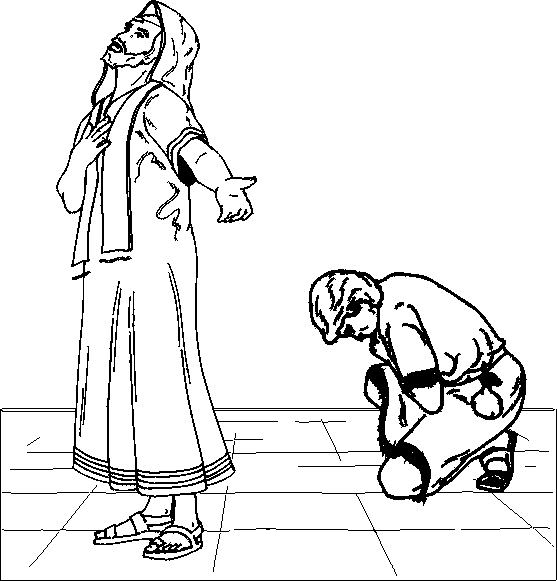 Our senior pastor Larry Buxton, who’s a baseball nut, says that parables are supposed to be stories that have a “late-breaking curveball.” He threw a curveball this past weekend with his sermon on the familiar parable of the Pharisee and tax collector in Luke 18:9-14. The Pharisee says, “I thank you God that I’m not like other people,” and the tax collector says, “Lord, have mercy on me, a sinner.” Pastor Larry shared that too often, we come away from this parable thinking that the moral of the story is to be more conspicuously self-deprecating in our prayer life. So we become people who say, “I thank you God that I’m a humble sinner, unlike those Pharisees who thank you that they’re not like other people.”
Share this:

How I read the Bible differently than John MacArthur
 A friend pointed me to Tim Challies’ recent interview with John MacArthur in which MacArthur doubled down on the claims made in his Strange Fire conference condemning the charismatic movement in Christianity. While I don’t have time to consider MacArthur’s scriptural arguments exhaustively, one of the passages he used to support his cessationist view that the Holy Spirit has stopped revealing things to people in the way that happened in Biblical times is Ephesians 2:20. I find his use of this passage providentially ironic and a good opportunity to illustrate how differently we read the Bible.

 Mercy not Sacrifice